
Hawthorne's City Directory Shelf
Hawthorne city directory research begins with a catalog question: is the name filed under Hawthorne, a South Bay title, or a larger Los Angeles suburban volume? The official material located for this area supports a careful search, but it does not support an invented publisher list. The table separates known repositories from runs that still need a staff query.
| Collection | Years | Where Held | Access |
|---|---|---|---|
| LA County Library Californiana city directories | Dating from the 19th century; Hawthorne run not itemized online | Norwalk Library closed stacks | Catalog and reference appointment |
| California State Library city directories and telephone books | Statewide city-by-city holdings; exact Hawthorne result needs a query | California History Section, Sacramento | Catalog, research room, remote reference |
| Regional criss-cross and householder volumes | Exact Hawthorne years not verified | Norwalk Californiana and State Library catalogs | Search suburban and South Bay titles with staff help |
| Hawthorne Historical Society local materials | Street-history context from 1905 onward; directory run not verified | Historical Society collections and website | Online chronology and inquiry |
Official catalogs reviewed did not expose an exact Hawthorne publisher and year run, a verified reverse-directory run, or a scanned Hawthorne entry. Search Los Angeles suburban, South Bay, Inglewood-Hawthorne, Polk, and Haines catalog language before assuming a volume exists. That honest gap is useful: a researcher can ask for a title, year, publisher, and call number instead of citing a directory no repository has confirmed.
Note: A catalog title that says Los Angeles suburban may contain Hawthorne without making Hawthorne its publication city.
Hawthorne Directory Research at Norwalk
Hawthorne Library's official branch page lists the local starting point at 12700 Grevillea Avenue, Hawthorne, California 90250, phone (310) 679-8193. Hours are Tuesday and Wednesday noon to 8 p.m., Thursday through Saturday 10 a.m. to 6 p.m., with Monday and Sunday closed. Confirm before travel. Staff can test catalog terms, point to yearbooks, and connect a local question to the Hawthorne Historical Society.
The Hawthorne Historical Society's local-history source adds a visual street and place clue to the library reference trail.
The branch is a reference lead, not proof that every local volume sits on an open shelf. The deeper county collection is the LA County Library Californiana material in closed stacks at Norwalk Library, 12350 Imperial Highway. Its description reports more than 24,000 books and more than 200 newspaper and magazine titles on paper or microfilm, plus California census schedules from 1850 through 1910, the Los Angeles Star from 1851 through 1879, nineteenth-century city directories, county histories, and state documents.
Insider tip. Norwalk places the 1851-1957 real-estate records on one level and later records on another, so a directory and deed research day needs separate appointments and shelf requests.
Regional Hawthorne City Directory Holdings
The California State Library California History Section maintains city-directory and telephone-book holdings databases and a research room. Search both Hawthorne and regional Los Angeles titles. A suburban volume may group several nearby communities, so a catalog query for the place, street, year, and publisher is stronger than a broad request for “the Hawthorne directory.”
The California State Archives is a historical fallback for government series and catalog guidance, not a guaranteed Hawthorne directory repository. Ask with a surname, date range, city, and record group. The Hawthorne Historical Society adds local articles, maps, and donated material, while the State Library and Norwalk shelves are the better first checks for telephone and directory volumes.
Decode a Hawthorne City Directory Entry
A Hawthorne city directory entry is a dated clue, not a complete household file. Standard Los Angeles-area volumes may place a surname and given name first, add a spouse in parentheses, give an occupation or employer, and then show a home address. A business address and telephone may appear on another line. A widow marker can identify a family transition, but it must be read against that volume's own front matter.
| Surname and name | Search the alphabetical line, including initials, hyphens, diacritics, and former names. |
|---|---|
| Spouse | Often appears in parentheses or after the head name; confirm the volume's style. |
| Occupation or employer | A historical affiliation clue, not proof of a current role or residence. |
| Home or business address | Separate the residence line from a business listing and preserve the printed street form. |
| Telephone or widow marker | Subscriber and widow notations vary; absence can mean non-listing, not absence from the household. |
- Criss-cross directory
- A reverse volume arranged by street and house number, often showing an occupant or subscriber and telephone.
- Householder index
- An address-oriented aid that groups the principal household name, but may omit other residents.
- Abbreviation key
- The volume's own decoding page for marks such as h, r, emp, and wid; photograph or transcribe it first.
Owner or renter marks, where used, are volume-specific and do not turn a historical line into proof of present occupancy. AB 64 now permits specified diacritical marks on California vital certificates, so preserve original name forms before normalizing a match.
Hawthorne's Criss-Cross Address Trail
Reverse directories answer a different question from an alphabetical city directory. Start with a street and house number, then read the occupant or subscriber line. The official local research record does not verify a Hawthorne-specific reverse run, so treat a regional catalog hit as a lead until staff confirm its years and coverage. Later telephone books may list only a subscriber, address, and phone. The Hawthorne Historical Society chronology is the local cross-check for an old street form.
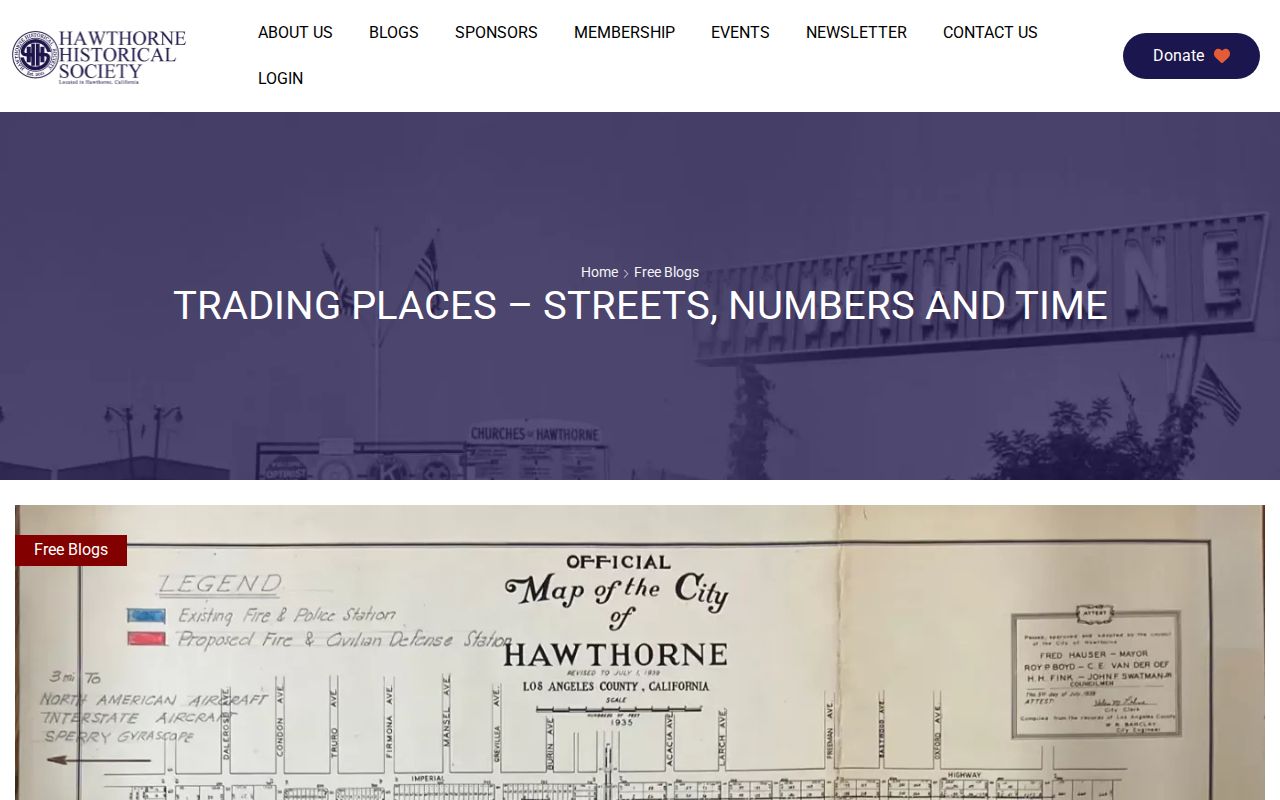
The chronology records the 1905 townsite context, the change from Ballona Street to El Segundo Boulevard around 1914, and later named-to-numbered street changes. Search both forms, then use a tract, lot, or parcel clue when a volume crosses the change.
Note: A missing surname line can mean a move, death, non-subscription, or an unlisted household member, not a clean departure date.
Trace Hawthorne Households Across Directories
For family history, keep one address and one name variant in view at the same time. A directory interval brackets a household's appearance; it does not prove the day someone arrived or left. Pair the historical shelf with library census databases and catalog searches for Los Angeles County land, probate, naturalization, and vital material.
- Fix the historical address with the printed street form, the local chronology, and any tract or lot description.
- Search the alphabetical volume, then check the criss-cross or householder section for the same year.
- Record every surname, spouse, address, telephone, occupation, and notation exactly as printed.
- Move through available editions and mark first, last, and changed-address appearances without treating gaps as proof.
- Pair the nearest directory with the 1910, 1920, 1930, 1940, or 1950 census and compare household relationships.
- Use newspapers, yearbooks, obituaries, probate, and deeds to test a family connection rather than relying on one line.
When a name disappears, check a new surname, a widow notation, a business-only listing, a street rename, and the next census before closing the trail. If the goal shifts to a present record, the Hawthorne resident lookup can separate a historical clue from a current official role.
Hawthorne Directories Beside the 1910-1950 Census
The county Californiana collection includes census schedules from 1850 through 1910, while the federal census is publicly available through 1950 under the 72-year rule. For a city founded as a 1905 townsite and incorporated in 1922, the 1910 through 1950 schedules are the most useful household checkpoints. They add relationship, age, birthplace, occupation, and, in 1940, residence five years earlier.
| 1905 | Hawthorne townsite context begins; search county geography and neighboring descriptions. |
|---|---|
| 1910 | Early Hawthorne-area household checkpoint before incorporation. |
| 1920-1930 | Compare household names with subdivision growth and changing street forms. |
| 1940 | Use the five-year residence field to test a move between directory editions. |
| 1950 | Newest public enumeration as of 2026; 1960 is not yet open. |
A census line and a directory line serve different purposes. The census describes an enumerated household at a fixed time; the directory may reflect a subscriber, business contact, or annual update. Match names and addresses, then state which source supplied each fact.
Hawthorne Yearbooks, Newspapers, and Sanborn Maps
Yearbooks can reconnect classmates, school clubs, and graduating households when a city directory is missing. Newspapers add announcements, obituaries, businesses, and address clues. The Norwalk Californiana shelves are especially useful because they combine directories with newspapers, magazines, histories, and microfilm. Search the surname with both the old and current street name.
The Library of Congress Sanborn search instructions explain how to test place and date catalogs, identify digitized public-domain sheets, and recognize later access limits.
A Sanborn map shows footprint, use, materials, outbuildings, and historical street configuration; it does not name every resident. Federal census and affiliate-library access likewise work as finding aids and household checks. Preserve the catalog title and image date so a map or index is not mistaken for a full city directory.
Hawthorne's Directory Catalog Gap
The missing exact run is itself a research result. Official catalogs reviewed did not expose a Hawthorne publisher and year sequence, a confirmed reverse-directory sequence, or a scanned sample entry. That means a reliable citation should say “exact run requires staff confirmation” and name the search terms used. Ask Hawthorne Library, Norwalk Californiana, and the California State Library for Hawthorne, Los Angeles suburban, South Bay, Inglewood-Hawthorne, Polk, and Haines titles.
The California State Archives catalog and research-room page is a useful comparison point for older government records, but it should not be described as holding a Hawthorne directory unless a catalog record proves it.
Catalog myth. A directory title that omits Hawthorne can still include its streets, while a title that names Hawthorne is not proof of a complete run. Verify the volume, year, publisher, and page range before quoting it.