
How Hawthorne Residents Are Found
A useful Hawthorne residents directory search separates ownership, occupancy, civic registration, court involvement, and historical residence. The Los Angeles County Assessor Portal is a strong first stop when an address or parcel is known. The Registrar-Recorder/County Clerk, often shortened to RR/CC, holds recorded instruments, but its deed index is not a web search. The Superior Court of California, County of Los Angeles, can expose a party or defendant in a case. Libraries and archives add the household layer that current property systems do not contain.
Each result answers a narrow question. An assessor record links assessment facts to an AIN, the Assessor Identification Number. A deed shows a grantor or grantee in a recorded transaction. A voter record concerns a registered voter and is protected by purpose rules. A directory entry may show a subscriber or occupant for one year. A match becomes useful only when the role, date, address, and name details line up.
- Start with a known address, AIN, name, or historical year and write down the exact question.
- Use the county assessor or a court search for the record type that fits that question.
- Join the result to a second fact, such as a parcel, spouse, date, business, or case number.
- Use the RR/CC counter, a library reference desk, or a focused city request when no online index exists.
- Confirm important facts with the office that created or keeps the record.
For one person, the Hawthorne resident lookup workflow is narrower. For a whole street, the by-address method is the better fit.
Hawthorne Resident Records Offices
Hawthorne is an incorporated city in southwestern Los Angeles County, not a separate county records jurisdiction. The city clerk is the first stop for minutes, ordinances, contracts, planning material, permits, and identifiable municipal or police records. County offices hold deeds, assessment records, voter registration, and county vital records. Court matters go through Los Angeles Superior Court, while federal matters belong to the Central District of California.
The office choice controls the search method. RR/CC maintains real-estate records from 1851 to the present, yet keeps the name and year indexes at its Norwalk headquarters. The assessor offers online AIN, address, legal, and map modes. California My Voter Status authenticates a voter checking their own record. Those are not interchangeable versions of one residents directory.
Los Angeles County RR/CC
12400 Imperial Highway
Norwalk, CA 90650
(800) 201-8999, option 3
Los Angeles County Assessor
Countywide parcel roll
Online and public counter routes
AIN or address search
Registrar of Voters
12400 Imperial Highway
Norwalk, CA 90650
(800) 815-2666, option 2
Choose the Right Hawthorne Record
A current resident question often begins with a name, but the strongest source may be keyed to another object. An AIN anchors land. A case number anchors a court file. An entity number anchors a business. A date of death anchors probate and vital research. Starting with the wrong key creates a false sense of completeness.
| Question | Best first source | What it can show | Important limit |
|---|---|---|---|
| Who is tied to this parcel? | Assessor Portal | AIN, situs, legal description, assessed facts | Not an occupancy roster |
| Who transferred an interest? | RR/CC index | Grantor, grantee, year, instrument trail | No Internet or address index |
| Was a person a court party? | LASC Find a Case | Case number, role, filing date, selected documents | Name searches are paid |
| Was a person registered? | My Voter Status | Own status, party, polling and district data | Self-authentication only |
| Who lived there decades ago? | Library and archives | Directory, census, newspaper, or map evidence | Exact Hawthorne runs need staff confirmation |
Owners, residents, voters, litigants, licensees, and mailing recipients are different roles. A residents directory becomes more accurate when every name is labeled with the role and date the source actually supports.
- Roll
- A recurring government list, such as an assessment or registration file, organized for an official purpose.
- Index
- A finding aid that points to a record. It may show a name and date without showing the full instrument.
- Criss-cross directory
- A reverse directory arranged by street and house number instead of surname.
- Parcel
- A defined piece of land identified by an AIN and legal description, even when its street label changes.
Current Hawthorne Directory Sources
There is no single open Hawthorne residents directory with every household. Current sources are better treated as a coverage map. The county assessment roll concerns parcels and owners. Recorded documents concern parties to instruments. City files show applicants, project contacts, and other people named in public business. State searches can show a licensee or business agent, but a professional or registered office address is not proof of a home.
| Source | People or places | Keeper | Access |
|---|---|---|---|
| Current assessment roll | Parcel ownership role | Los Angeles County Assessor | Free Basic, Legal, and Map search |
| Recorded real-estate index | Deed and lien parties | Los Angeles County RR/CC | Norwalk appointment and copy requests |
| City planning and permit files | Applicants, owners, contractors, site addresses | Hawthorne departments | Online pages or defined request |
| Business and license searches | Entity agents and licensees | California SOS and DCA | Free searches, record limits vary |
| Public court index | Parties, defendants, case roles | Los Angeles Superior Court | Case access, paid name search, terminal |
Neighborhood organizations may publish an officer or meeting contact, but a private membership roster is not a public residents list. The same caution applies to city commissions, yearbooks, congregations, and civic clubs: a public role or notice is evidence of that role, not a complete household profile.
The Norwalk Deed-Index Detour
Los Angeles County’s recorder records reach back to 1851, which is unusually useful for a Hawthorne address that crosses the city’s 1905 townsite and later subdivisions. The catch is central to any Hawthorne residents directory search: RR/CC does not publish its name and address index on the Internet. The county cites the risk of exposing protected officials’ home addresses. A searcher must use the alphabetical grantor and grantee books by name and recording year at Norwalk.
RR/CC’s office page divides the physical collection into 1851-1957 material on the lower level and 1958-present material on the second floor. The index gives a document number or book and page that can support an order. Copies can be requested online, by mail, fax, or in person. The office says online copy orders are processed within 20 working days from receipt. The index itself is not a phone search, and an address cannot be used as the index key.
| Index field | Grantor or grantee name, plus the recording year |
|---|---|
| Retrieval clue | Document number or book and page after an index hit |
| Recorded image | Ordered or viewed through RR/CC, not a free web click-through |
| Contact | 12400 Imperial Highway, Norwalk, CA 90650; (800) 201-8999, option 3 |
For a street or prior-owner trail, start with the assessor’s AIN and legal description, then carry the current name to the RR/CC counter. The full address mechanics belong in the Hawthorne by-street directory workflow.
What the Assessor Portal Joins
The Los Angeles County Assessor Portal offers three useful modes. Basic Search accepts an AIN or address. Legal Search is organized around the legal description. Map Search lets a researcher select a mapped parcel and then move to nearby parcels. The AIN is the stable join key when a street number, mailing address, or municipal label changes.
| Portal control | Type | Required | Format or purpose |
|---|---|---|---|
| Search by AIN or Address | Text/autocomplete | Yes | AIN or standardized street address |
| Basic Search | Mode tab | Mode | Direct address or AIN lookup |
| Legal Search | Mode tab | Mode | Legal-description-oriented search |
| Map Search | Mode tab | Mode | Pan, zoom, and select a parcel |
| Search | Button/icon | Yes | Runs the selected query |
Results can include the AIN, situs, legal description or parcel-map reference, roll year or effective date, assessed land and improvement values, building facts, and map context. The public interface does not advertise an owner-name search. It also does not turn an assessed owner into a list of everyone living in the parcel.
For the county contact route behind a records question, see the Los Angeles County RR/CC contact page before traveling or ordering a copy.
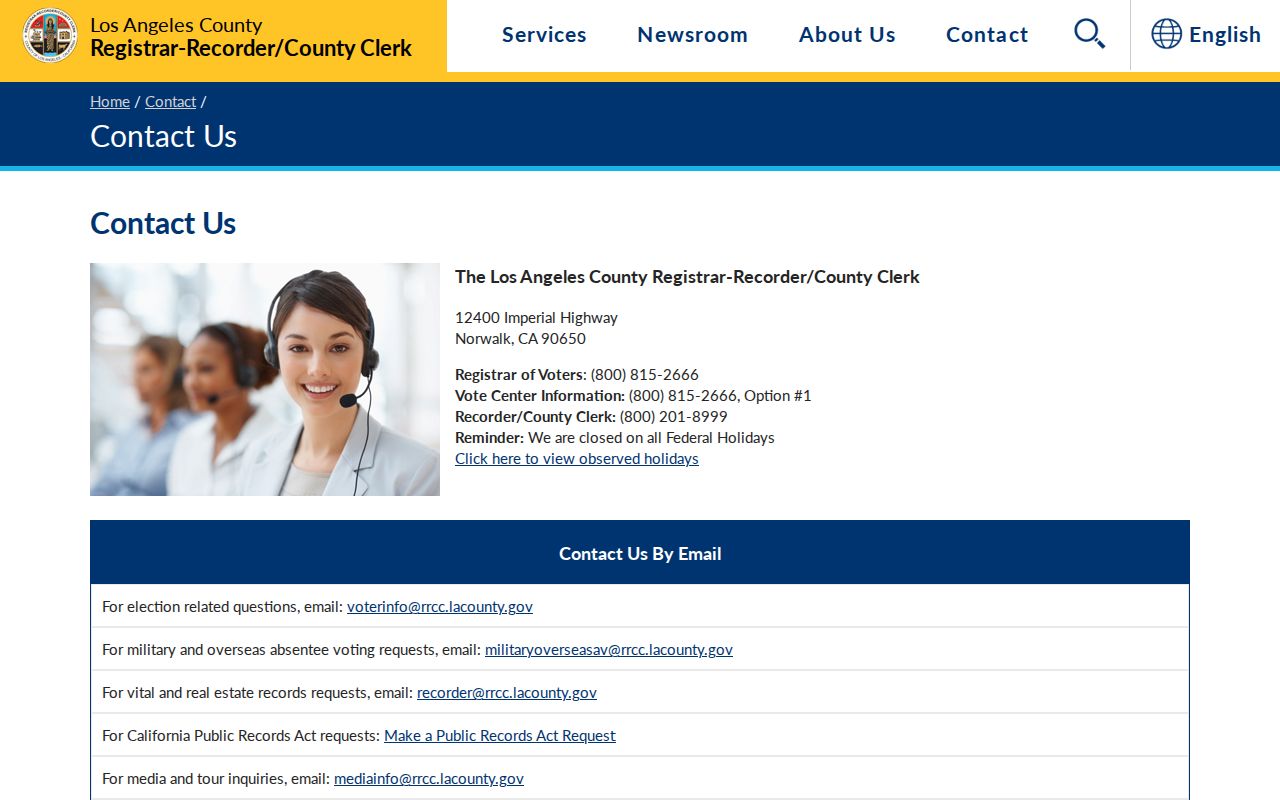
The county contact route helps separate recorder, assessor, tax, and election questions before a request is sent to the wrong custodian.
California Voter Access Has a Purpose
California My Voter Status is a self-lookup tool. It asks for first name, last name, date of birth, and an identity validation tied to a California driver license, state ID, or the last four digits of a Social Security number when the record contains that data. A voter can see registration status, party preference, polling information, district details, ballot status, and guide-delivery preferences. It does not let a stranger enter a person’s name and browse a block.
Full voter data is limited by Elections Code section 2194 and 2 CCR sections 19001-19012. Election, scholarly, journalistic, political, and governmental purposes are treated differently from arbitrary personal or commercial browsing. A qualified file request requires an identified purpose, organization details, requested geography and fields, security commitments, and payment. A specific-voter request can cover up to ten named people with identifying information, but it is not an unnamed street list.
Myth check. A California voter roll is not an open Hawthorne neighbor directory. Use the authenticated self-lookup or a lawful qualified request, and never treat a registration record as proof of present occupancy.
For an authenticated voter’s own record, use California My Voter Status. The county Registrar of Voters can be reached at 12400 Imperial Highway, Norwalk, or (800) 815-2666, option 2.
California privacy guidance reinforces the difference between a public record and a free-standing list of private households.
Hawthorne Court and Probate Names
The Los Angeles Superior Court Find a Case page separates case-number access, calendars, document images, civil or probate party searches, and criminal defendant searches. Civil name fields can use a party last name or company and, when helpful, a first name. Criminal searches use defendant last and first names. Exact Match and Starts With controls make name variants worth testing, but a result still needs a role, filing date, case type, and location check.
Published online coverage is 1983-present for unlimited civil, family law, and probate; 1991-present for limited civil; and 1992-present for small claims. Case-number and calendar routes can be free, while party-name searches cost a fee and may remain visible for 24 hours. Selected document images have different cutovers, and confidential, sealed, juvenile, adoption, paternity, and protected family material is not open online.
| Search field | Type | Use |
|---|---|---|
| Party last name or company | Text | Civil name discovery; Exact Match or Starts With |
| Party first name | Text | Narrows a personal-name match |
| Defendant last and first name | Text | Criminal defendant search |
| Case number | Text | Direct case summary and later review |
| Case type or service tile | Tab/button | Civil, family, probate, criminal, calendar, or images |
Probate is a practical heir trail. Staff can work from a full decedent name and date of death, and a courthouse public terminal can open a located case number. Petitions, notices, and distribution orders may connect a former owner to property, subject to public-file limits.
See the official Los Angeles Superior Court case search before assuming a Hawthorne matter belongs to the closest courthouse. Federal cases use the Central District of California and PACER instead.
Identity-recovery resources are separate from a court index and should not be treated as a resident roster.
Vital Records Need the Right Eligibility
Birth, death, marriage, and dissolution records are certificates with access rules, not an open people index. Los Angeles County RR/CC handles county events, while the California Department of Public Health provides statewide certified records and a limited dissolution certificate route. California has no universal rule that makes every birth record public after 100 years or every death record public after 50 years.
An authorized certified copy is limited by relationship or role. An informational birth or death copy is generally available to many requesters but is marked not valid to establish identity. Confidential marriage records are available only to a party or by court order under Family Code section 511. Adoption files and original birth records require specialized statutory or court procedures.
| Record | Local or state route | 2026 CDPH fee | Key limit |
|---|---|---|---|
| Birth | RR/CC or CDPH | $31 | Authorized versus informational copy |
| Death | RR/CC or CDPH | $26 | Requester treatment varies |
| Marriage | RR/CC or CDPH | $19 | Confidential marriage is narrower |
| Dissolution | LASC judgment or CDPH certificate for its period | $18 | Judgment comes from the court |
Common application fields include the registrant or decedent’s full name, event date and place, parents or spouses, requester relationship, purpose, signature, and payment. Mail requests may need a sworn statement or notarization. The 2026 fee change follows AB 64, and specified diacritical marks may now appear on California vital certificates. Search exact names while preserving the spelling in the source.
Start with California Vital Records applications when the event or eligibility is statewide.
The California consumer complaint channel is useful when a record is being misused, but it does not replace the vital-record custodian.
Hawthorne City Requests Fill the Gaps
City-created material often answers a question that county portals cannot. Hawthorne’s clerk retains official documents, ordinances, resolutions, contracts, agreements, agendas, petitions, claims, lawsuits, notices, and other city records. Planning applications, permits, code cases, business-license material, police reports, and commission files may name an applicant, owner, contractor, site address, or public participant.
A request should identify a record, date span, department, address or APN, and preferred delivery. Ask for electronic copies when available. The California Public Records Act does not require the city to create a new residents directory or answer a broad question. The city generally determines within 10 calendar days whether responsive disclosable records exist, with a written extension of up to 14 additional days for unusual circumstances. Production can take longer, and inspection is ordinarily free.
- City Clerk
- 4455 W. 126th Street, Hawthorne, CA 90250; main (310) 349-2900; direct clerk line (310) 349-2915.
- Counter hours
- Monday through Thursday, 9:00-11:00 a.m. and 2:30-4:30 p.m.; City Hall is closed Friday.
- Email route
- Completed identifiable-record requests may be sent to cityclerk@cityofhawthorne.org.
- Useful description
- Include department, site address or parcel, date range, and whether inspection or copies are wanted.
Complaints, investigative material, victim details, and other protected information may be withheld or redacted. A focused request for a permit or planning file is different from asking the clerk to compile everyone associated with Hawthorne.
The Hawthorne City Clerk records page is the official starting point.
California public-record guidance explains the request framework, while the city decides what it holds and what an exemption protects.
Historical Hawthorne Resident Directories
Printed city directories, telephone books, criss-cross volumes, census schedules, yearbooks, newspapers, and local history collections are the historical side of a Hawthorne residents directory. LA County Library’s Californiana Collection is in closed stacks at Norwalk Library. Its description includes more than 24,000 books, more than 200 newspaper and magazine titles, California census schedules from 1850-1910, the Los Angeles Star from 1851-1879, nineteenth-century city directories, county histories, and state documents.
Exact Hawthorne publisher and year runs were not exposed by the official catalogs reviewed. Hawthorne may appear inside Los Angeles suburban, South Bay, Inglewood-Hawthorne, Polk, or Haines volumes rather than under a separate Hawthorne title. The California State Library California History Section and the Hawthorne Library reference desk are the right places to test those catalog terms. A reverse directory sorts by street and house number; an ordinary volume sorts by surname and may include spouse, occupation, employer, address, or telephone.
Directory absence does not prove a person was absent. A move, death, non-subscriber status, publication gap, name variant, or omitted unit can explain a missing entry. Pair a directory year with the nearest public census, preserve the volume’s own abbreviation key, and use an obituary, probate file, deed, or school yearbook as a separate check.
The deeper collection trail is described in the Hawthorne city directory collections page.
The federal fraud-reporting channel is separate from historical research and should be used when a copied directory detail is being used in a scam.
Hawthorne Street Names Hide Old Matches
Hawthorne’s street history can make one address look like several. The 1905 townsite is the starting point. Inglewood-Redondo Boulevard became Aviation Boulevard. Ballona Street became El Segundo Boulevard around 1914. Hawthorne Avenue became Hawthorne Boulevard probably in the 1930s. Named east-west streets shifted to numbered streets between 1935 and 1938, and Fifth, Sixth, and Seventh later became Ramona, Truro, and Eucalyptus between 1932 and 1935. Other ordinal streets changed in the 1960s.
Use the AIN, tract, lot, block, and legal description as the bridge. Search old and new street forms in newspapers, directories, court papers, and deed-related descriptions. Keep the Historical Society’s uncertainty words, such as “probably” and approximate ranges, rather than turning a local chronology into a false exact date.
Address clue. A stable parcel identity can connect a renamed street, an old directory entry, and a later deed even when the written address changes.
The Hawthorne Historical Society street chronology supplies the local evidence. A current postal label alone cannot resolve an older house.
Privacy and Lawful Directory Research
Public availability is not permission to build a private household dossier. California’s Safe at Home program gives eligible survivors and certain reproductive-health participants a substitute address and mail-forwarding route. Protected voter records and specified officials’ home information receive additional treatment. Recorded documents can be corrected or redacted only through official processes, not by a casual request to a directory publisher.
Use official records for genealogy, an heir question, a property-history project, civic transparency, or reconnecting with someone through a lawful channel. Do not use public names or addresses to stalk, harass, intimidate, or repeatedly contact a person. A compiled commercial tool can be stale or conflate people; it does not override the custodian’s limits or turn an inference into proof.
When personal data is misused, California’s Attorney General complaint and privacy resources, the Secretary of State, the county custodian, or law enforcement may be the right next contact. A focused records question, a clear role label, and a second source make a Hawthorne residents directory search both more accurate and less intrusive.
Privacy rights can limit a broker copy without erasing a deed or court file held under a separate disclosure law.